


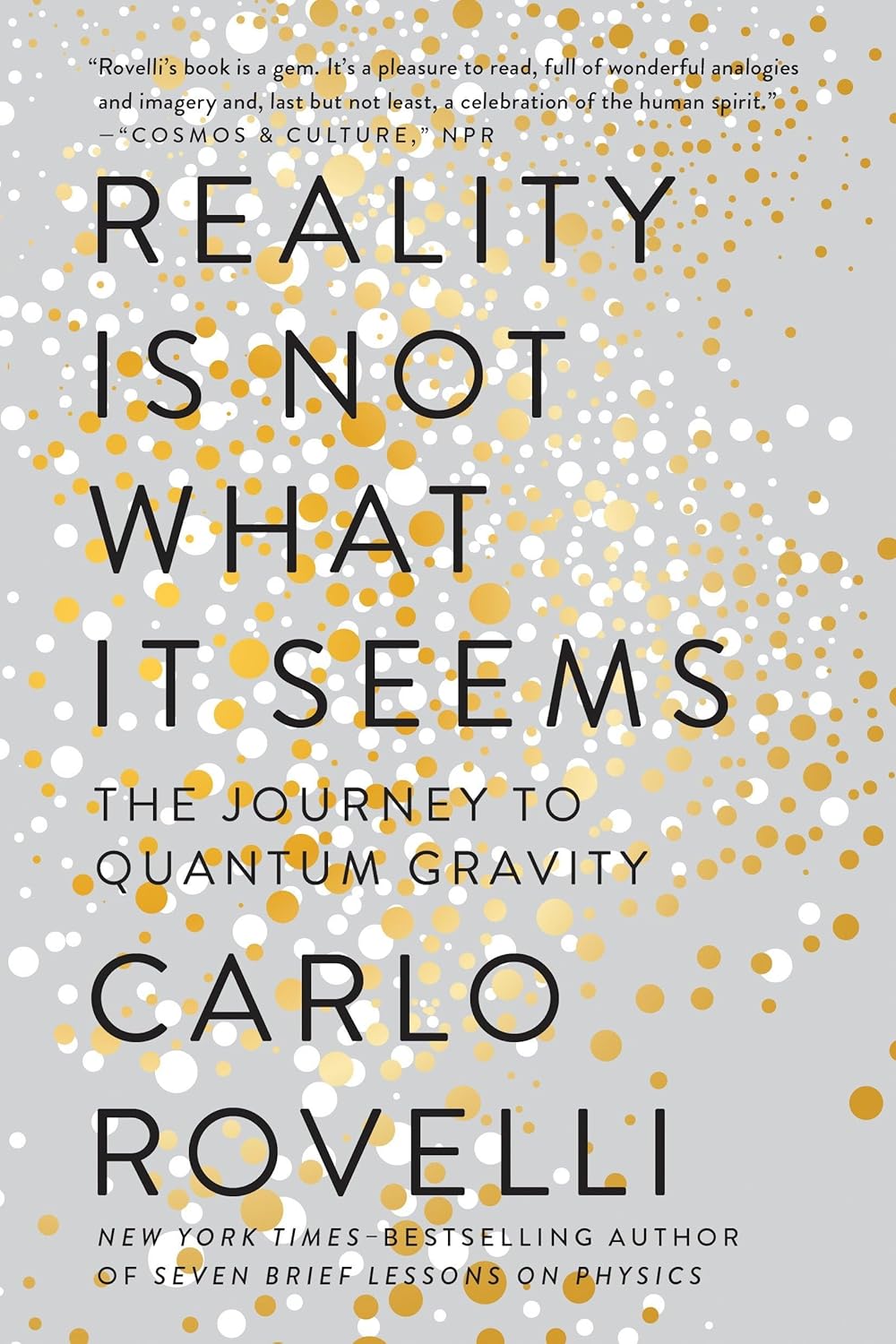

Price: $18.00 - $12.33
(as of Mar 16, 2025 18:58:29 UTC – Details)
“The man who makes physics sexy . . . the scientist they’re calling the next Stephen Hawking.” —The Times Magazine
From the New York Times–bestselling author of Seven Brief Lessons on Physics, The Order of Time, and the forthcoming Helgoland, a closer look at the mind-bending nature of the universe.
What are the elementary ingredients of the world? Do time and space exist? And what exactly is reality? In elegant and accessible prose, theoretical physicist Carlo Rovelli leads us on a wondrous journey from Democritus to Einstein, from Michael Faraday to gravitational waves, and from classical physics to his own work in quantum gravity. As he shows us how the idea of reality has evolved over time, Rovelli offers deeper explanations of the theories he introduced so concisely in Seven Brief Lessons on Physics. Rovelli invites us to imagine a marvelous world where space breaks up into tiny grains, time disappears at the smallest scales, and black holes are waiting to explode—a vast universe still largely undiscovered.
Publisher : Riverhead Books; Reprint edition (January 23, 2018)
Language : English
Paperback : 288 pages
ISBN-10 : 0735213933
ISBN-13 : 978-0735213937
Item Weight : 2.31 pounds
Dimensions : 5.41 x 0.77 x 8.16 inches
Customers say
Customers find the book accessible and engaging. They appreciate the historical exploration and explanation of scientific thought from ancient Greece. The exposition helps readers understand quantum physics and relativity better than ever. Readers describe the book as fascinating and enjoyable, leaving them with a sense of wonder.





Randolph Eck –
The nature of reality
According to the author, this book “gives an account of the current state of the search for our new image of the world” as he understands it today. It is the reply to the question, “So, what do you think is the true nature of things?”We start with history. We are going back to Miletus about 26 centuries ago. It is important to start with the roots, and how an important number of ideas turned out to be effective in understanding the world. We are introduced to a number of important people and their contributions to human thinking. One of the greatest was Anaximander. In fact, the entire scientific and philosophical tradition has a crucial root in the speculations of the thinkers of Miletus. Two other innovative thinkers were Leucippus and Democritus. An intense humanist, rationalist, and materialist thought emerges from what we know of the work of these thinkers. Unfortunately, their original books have vanished, or perhaps destroyed by monotheistic cultures. Later Plato and Aristotle actually fought against their ideas, publishing new ideas, some of which actually created obstacles to the growth of knowledge. Incredibly, Democritus had arrived at the idea that everything is made of indivisible particles. We see this verified by Einstein, a long, long time later, in something called Brownian motion. But, before Einstein, we have the works of Galileo and Newton, which the author elaborates on. Later on, we have the works of Faraday and Maxwell, which have enhanced our understanding of electromagnetism and light.In the section on quanta, the author delves into a strange physics. He discusses in depth three aspects of reality: granularity, indeterminism, and relationality. First, through discoveries such as Brownian motion, we see the granular structure of matter, the energy of the electrons in the atom, and even light itself. Through the work of Niels Bohr, Werner Heisenberg, and Paul Dirac, we are enlightened of the strangeness of quantum mechanics. Strangely, particle’s properties (position, velocity, etc.) acquire reality only when they interact with another object. No variable is defined between interactions! “The relational aspect of the theory becomes universal,” according to the author. The work of these Giants leads us to something called “quantum field theory.” This is the general form of quantum theory compatible with special relativity. We see the progression from Newton to quantum mechanics defining fields and particles and then just quantum fields whose elementary events happen in spacetime. The author makes a startling claim that “Quantum mechanics does not describe objects: it describes processes and events that are junction points between processes.” It is all quite fascinating, and this author always leaves me with a profound understanding of nature.From Part Three on, which talks about quantum space and relational time, things get a bit more difficult to understand. This is really a strange, strange world. The author asks what is quantum space, and what is quantum time? This is, in fact, the problem we call quantum gravity. We learn that there is a limit to the divisibility of space. Below a certain scale, nothing is accessible, or as the author puts it, “More precisely, nothing exists there.” At this scale, space and time change their nature, becoming quantum space and time. Understanding what this means is the problem. A theory is being erected to understand this; it is called loop quantum gravity. In explaining this, the author invokes “spin networks.” You’ll just have to read it yourself rather than me attempting to elaborate any further. The next chapter discusses time, where we learn that at a fundamental level, there is not time. This is an interesting chapter, albeit difficult to comprehend for me, nevertheless absolutely fascinating. And here we are introduced to another concept called “spinfoam.” We see, space has disappeared, time has disappeared, classic particles have disappeared, and classic fields have as well. The author has shown us how the understanding of nature changed from Newton, to Faraday and Maxell, to Einstein in 1905, to Einstein in 1925, to quantum mechanics, and finally to quantum gravity. What is left is something called “covariant quantum fields.” What we have is “discrete elementary entities not in space and time, but weaving space and time with their relations.”So we don’t need all the new fields, strange particles, extra dimensions, various symmetries, parallel universes, strings, etc. According to the author, the pieces of the puzzle are simpler: general relativity, quantum mechanics, and the standard model. The loop quantum gravity community just needs to figure out how to combine them in the correct manner. In the final chapter, the author leaves us with an important thought: “The centuries in which people had faith in what they believed were the centuries in which little new was learned.” We need to keep learning, accepting that what we think we know may turn out to be wrong. “Science is born from this act of humility.”
PembrokeSorbonne –
Loop Quantum Gravity delivered in Hawking’s lucid science writing style
This book offers an exceptionally clear presentation of Loop Quantum Gravity(LQG) by one of its founding proponent Carlo Rovelli. It is written in Hawking style of lucid and engaging prose. It was a pleasurable read, which is a science writing achievement for a very unintuitive theory requiring you to do away with space time. The idea of doing away with space and time is probably the hardest thing for the reader to comprehend, but Rovelli did a stellar job of leading his readers through.Similar to many science books that explains a new theory, the author recaps a history of physics that has bearing to his project. Rovelli begins with Anaximander, Democritus, Plato, Aristotle, Archimedes to Newton and Einstein in part one of the book. It is delightful reading. But if you don’t want to get through all that history again, you can start from part II beginning with general relativity and quantum mechanics. It is advisable to read through his relational view of Quantum mechanics because his LQG uses a relational view of reality. Rovelli sees quantum mechanics as describing quantum states of “interacting particles” (only a relationship, not as strong as entanglement). Quantum state arises from particle interacting with each other. He also sees information of quantum states as finite.The presentation of LQG is between chapter 5 to 7. LQG suggests space is made up of quanta of gravitational field. So quanta is more fundamental than space. The quanta is a node that can connect to another node or quanta by links or field lines. In LQG, space is replaced by quanta of gravitational field in a granular structure. A graph which represents how the quantas of gravitational field are connected is a spin network. This spin network is what space consists in.Not only is space is replaced. Time is also replaced by variables of activity such as heart beat, pulse, or pendulum swing. The notion of time flows by itself is less useful than noticing passage of activities such as beat or pendulum swing instantiating in the real world. Activities in the universe is more direct measure of the passage of reality.Using quanta of gravity and variables of activity, LQG presents a new representation of reality using gravity and quantum mechanics to replace space-time. When quantum mechanics is involved, events instantiate under probability and actual quantum event fluctuations. Reality is hence once again contingent upon relation of activities.Rovelli further presents the application of LQG by using it to study black holes. Heat dissipated in Hawking Radiation can be studied by the spin network that describes the gravitational field on the horizon of the black hole. Another use of LQG is to assess the black hole collapse. Quantum fluctuation and repulsion prevent collapsing to infinite pressure but offers it to bounce out. This approach is brought over to modeling the Big Bang suggesting that the initial explosion to be a big bounce from quantum fluctuation, not unlike the negative potential of Linde and Vilenkin inflation model.This book brings the reader through a journey to reconceptialise their reality in quanta of gravity, spin network and spin foam. It is conceptually challenging but Rovelli’s lucid and engaging narrative made it fun and worthwhile.
Binu v. –
I am an ardent reader of physics subjects, I have read many books on physics ,but only a few of them imparted a satisfactory outlook so that a person with basic awareness of physics can understand it’s content, but this one is a amazingly special for the simple reason that a person with general awareness about physics can understand. It covered almost every topics of main theories of classical, relativistic and quantum mechanics with such brevity and simplicity… Thanks to the author who tried his level best to come to the strata of an average physics enthusiast. After reading this book I got immense satisfaction which no other books of the same sort could provide… This is a must read book and I assure that you will get something very special which you will experience later…
Mike Walters –
There is a solution. And Carlo Rovelli brings this solution by showing in a simple and impressive way that quantum mechanics and general relativity can ultimately be unified by a loop theory of a granular quantum structure of space. A new Einstein of the 21st century is born!
Luca –
Carlo Rovelli presenta come si è evoluta la visione del mondo per arrivare attraverso la quantum gravity ad un tentativo di coniugare l’indeterminazione della teoria quantistica con la granularità delle cose della relatività generale. Ci si è riusciti? Le due teorie oggi sopravvissute string e loop sono ancora divise pure se quest’ultima sta raccogliendo indizi a suo favore. A fronte della mancanza di certezza rimane lo spirito della scienza che dubita di ogni certezza e che trova il suo valore nel dare le risposte che servono consapevole che domani queste cambieranno. Un libro molto bello da leggere.
Mark Wessner –
Although Rovelli worships at the altar of science a little too enthusiastically for me, he does a great job of beautifully explaining both general relativity and quantum mechanics, and proposing how the two might actually work together. The exploratory discussions of information theory and thermal time are mind-bending. The book is well written, contains fascinating insights, and will push your intellectual limits!
Olaf van Kooten –
Mind bogelling, not easy but gratifying to read. The way reality is experienced through the lens of quantum gravity comes very close to what Buddhist philosophy claims as seeing nirvana in samsara.